


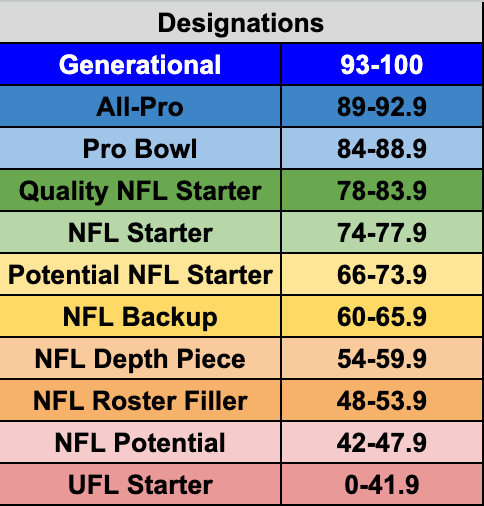
If you’re reading NFL Draft coverage right now, you know there’s a range of four to six wideouts who could land in the first round later this month. More often than not, there’s a first-round wideout who doesn’t belong; a player propped up by hefty college production without the translatable traits that suggest the player could be dominant at the NFL level. I certainly have an opinion on who that is this season, but I’m also not completely in line with the consensus on the top guys, either (as usual). This draft has some sleepers and gems, and I think this class is littered with guys who could be great No. 2s and 3s for various teams. It’s been a while since the 2026 quarterback article, so here’s a reminder about the designations:
And here’s how I rank the 2026 wide receiver class.
Quality NFL Starters
Carnell Tate | Ohio State
6022, 192 LBS | RAS: N/A | Position Rank: 1 | Prospect Grade: 82.41 | Round Grade: 1st
Tate has risen on my board drastically over the last few months, primarily because of his improvement as a route-runner and separator, while maintaining his elite catch-point flashes from his sophomore season. Tate is a technician, understanding leverage at the highest levels, utilizing a refined throttle to get defensive backs off balance, and flashing the elite athleticism to accelerate out of breaks. While he was never the primary option at Ohio State, he has No. 1 wideout written all over him, with prototypical size for an XWR, the strength to beat press coverage, and the ability to serve multiple roles. If a team needs Tate to be more of an underneath possession wideout, he can do that. If they need him to stretch the field vertically with speed and ball tracking, he’s the guy. His adjustments in the air are special, and contested-catch opportunities are heavily swayed in his direction due to his elite concentration and strong hands through contact. There are moments of hesitation and alligator-arming in the middle of the field, though some of that may have been due to his late-season injury. Tate is expected to come off the board within the first 20 picks, and a team should be getting a top-20 wide receiver in the NFL for the next decade, provided he stays healthy throughout his career.
NFL Comparison: George Pickens
Makai Lemon | USC
5111, 192 LBS | RAS: N/A | Position Rank: 2 | Prospect Grade: 81.41 | Round Grade: 1st
We’ve been fans of Lemon at TDR since he was a high school recruit, and he realized that potential in a major way in 2025. Lemon is virtually impossible to cover man-to-man, and his acute awareness of open space and holes in zone coverage makes him a matchup nightmare. What separates him from a lot of wideouts deemed “best out of the slot,” a designation that tracks for his NFL career, is his fearlessness at the catch point. Lemon has been incorrectly deemed a small wideout, mostly because he excelled in the slot and doesn’t have many snaps against press coverage, but he wins at the catch point like a 6’5 monster. He can go up and fight with the best of them, and he consistently shows a willingness to put his body on the line to make plays. That makes him a unique threat over the middle of the field. When he has the ball in his hands, he’s creative, explosive, and shifty, despite not being the fastest player in the world. The pace he plays with on his stems translates to his work after the catch, and it’s easy to envision a world where he’s one of the leading receivers in the NFL in both receptions and yards. That said, his work against press coverage is limited enough to have concerns about it, even though he’s a stocky player with a strong build. He can get pushed off routes at times, though he’s physical enough to hold an impact. Lemon is one of the most exciting wideouts in this class, and he should be viewed as a potential top option for an offense.
NFL Comparison: Jaxon Smith-Njigba
KC Concepcion | Texas A&M
5115, 196 LBS | RAS: N/A | Position Rank: 3 | Prospect Grade: 78.89 | Round Grade: 2nd
Concepcion was the biggest surprise when evaluating this wideout class, as the explosiveness, combined with the savvy route running, makes him one of the highest-upside guys in the group. Concepcion may not be the fastest wideout ever (he’s emphatically not), but he is lightning quick on the football field. He glides through his routes with pace and intention, with his speed terrifying corners on deep overs and other third-level routes. That fear allows Concepcion to break routes early and generate tons of separation, taking advantage of defensive backs on their heels. Against zone, Concepcion has a great feel for soft spots, settling into windows that allowed Marcel Reed to regularly find him. The athleticism and separation skills are there, but Concepcion has unusually frustrating hands. He drops easy balls, but catches challenging ones. He struggles with wide-open catches, but he wins contested catches at an impressive rate, considering his build. He struggled to find consistency from game to game, but some uneven quarterback play contributed to that. While the Jaylen Waddle comparison isn’t one-for-one, as the latter was more than two inches shorter and significantly lighter, the style of play Waddle and Concepcion displayed in college is strikingly similar.
NFL Comparison: Jaylen Waddle
NFL Starters
Jordyn Tyson | Arizona State
6021, 203 LBS | RAS: N/A | Position Rank: 4 | Prospect Grade: 77.64 | Round Grade: 2nd
Tyson is one of the most hotly debated prospects in the entire 2026 NFL Draft, as his upside resides somewhere in the Justin Jefferson range and bottoms out at “one-contract player” due to various concerns. At his best, Tyson is one of the best separators in the class, with a route-running style that mirrors the best players in the NFL. His catch radius is off the charts, and he makes difficult catches look simple with his ball tracking and high-pointing. When he wants to, he can be an impact player in the run game as a blocker, but the desire is frequently absent. He is extremely fluid in and out of his breaks, but he doesn’t possess elite top-end speed. He can get pushed off his routes against physical corners, which isn’t ideal for someone over 200 pounds. That limited him against man coverage more than evaluators would expect. The main questions with Tyson revolve around his injury history, as he’s yet to finish a college football season. Between broken collarbones, severe knee ligament tears, and more recently, nagging hamstring injuries, Tyson hasn’t been a model of perfect health since arriving on the college football scene. Teams have concerns about his toughness, both physically and mentally, with the latter introducing another problem found on Tyson’s film. He often checks out of games, gives about 50% effort, and costs his team yards. When he’s not the primary read, he’s completely disengaged. When he’s tasked with blocking on the backside, he never does. When he’s asked to block a frontside run, he often blocks for two seconds, checks behind to see if he needs to keep blocking, and loses the block. He’s as much a question mark as anyone in the class, and his wide range of outcomes introduces hesitancy in his long-term outlook.
NFL Comparison: Rashod Bateman
Omar Cooper Jr. | Indiana
6000, 199 LBS | RAS: 8.80 | Position Rank: 5 | Prospect Grade: 77.08 | Round Grade: 2nd
Cooper has been a late riser for many, and there’s enough in his profile to believe he can be a No. 1 option for a team if he lands in the right situation (though he’s likely best as a No. 2, similar to how he was deployed at Indiana in 2025). He’s a compact, sturdy player who gains yards after the catch with efficiency. His low center of gravity and lower-body strength allow him to break arm tackles and maximize the possibility of every screen or short pass that comes his way. He’s an excellent athlete, still learning how to pace himself through his stems. He often goes at 100 mph, keeping corners balanced and staying with him. Improving his throttle would improve his ability to separate, though he generally doesn’t have many issues separating. He’s excellent at the catch point, with explosive jump-ball ability compensating for his smaller stature. The catch to win the game against Penn State was arguably the catch of the year in all of college football, as he displayed the body control and focus required of a top-end wideout. Cooper will need to grow as a blocker and continue refining his routes, but he should be viewed as a player an NFL offense could revolve around.
NFL Comparison: Chris Godwin Jr.
De’Zhaun Stribling | Ole Miss
6021, 207 LBS | RAS: 9.57 | Position Rank: 6 | Prospect Grade: 76.78 | Round Grade: 2nd
Stribling was the most surprising evaluation of the entire class, as he graded out significantly higher than expected before the NFL Scouting Combine, and emerged as an even more complete prospect. He’s one of the most elite athletes at the position, with a 4.36s 40-yard dash highlighting his biggest strength. He’s a nightmare to cover on deep balls, as he can blow right past coverage. With the Ole Miss offense, he wasn’t utilized as a deep threat, but rather as an elite playmaker with the ball in his hands. 63.5% of his targets were under 10 yards, and he excelled at every level. When asked to run intermediate and deep routes, he averaged 16.22 yards per route run. To put that into perspective, Jordyn Tyson averaged 9.16, and Makai Lemon averaged 14.82. Stribling isn’t just a speed guy, though. He’s fluid in and out of breaks, especially when pushing vertically and breaking off for comebacks. He’s excellent at generating yards after the catch, combining his elite speed with physicality. He’s not elusive with the ball in his hands, but it generally doesn’t matter. He’s not an elite route runner, but he does enough at his size to believe he can be an impact player. He’s strong, consistently fighting off physical corners. He’s arguably the most underrated player in this receiving class, though how he’s deployed at the next level is critical to his career path.
NFL Comparison: Brian Thomas Jr.
