
Dynasty stashes aren’t lottery tickets. They’re asymmetric bets.
You’re not trying to predict a breakout on a calendar. You’re positioning your roster so that when clarity arrives, you already own the asset. The goal isn’t to chase hype once roles are defined; it’s to buy ambiguity before the market prices it in.
Winning dynasty managers aren’t better at reacting. They’re better at being early.
A true stash is a player whose value can change rapidly with new information. That information might be an injury, a depth-chart shakeup, a trade, or simply an opportunity finally arriving. If you’re waiting for box-score production, you’re already late.
What Makes a True Dynasty Stash
Before we talk player names, the framework matters more than the outcome. A true dynasty stash checks most (not necessarily all) of these boxes:
Low acquisition cost
Waiver wire, end-of-bench piece, or throw-in during tradesClear traits the NFL values
Size, speed, explosiveness, versatility, or positional scarcityAmbiguous or fragile depth chart
No locked-in long-term hierarchy ahead of themAt least two paths to value
Injury, role change, contract movement, scheme fit, or trade
If a player needs everything to go right, they aren’t a stash, they’re a prayer.
Types of Dynasty Stashes (How to Think About Them)
Not all stashes are created equal. Understanding why you’re stashing a player helps you know when to hold, when to buy, and when to move.
High-Potential Stash
This is a player with real talent who, if given the opportunity, could legitimately break out. The ceiling exists, the role doesn’t (yet).
Usually one opportunity away
Often buried behind veterans or established starters
The bet is on upside + traits
Limited Production Stash
These players haven’t put it together statistically, but the flashes are there. The talent shows up in moments, not yet in consistency.
Incomplete production profile
Film or usage hints at more
The market is impatient; you don’t have to be
Injury Stash
This can be a short-term or long-term play depending on severity. Injuries create temporary discounts, and dynasty is about exploiting timing.
Most common in-season, but viable year-round
Value often rebounds before the player even returns
Best executed via trades rather than waivers
Opportunity Stash
This is the “follow the situation” play. The door is opening, even if the player hasn’t walked through it yet.
Contract expirations ahead
Thin depth chart
Coaching or scheme changes looming
Opportunity creates fantasy value faster than talent alone.
Value Stash
This is strictly a market play.
You’re betting that at some point in the offseason or season cycle, perception changes, and when it does, you move.
Cheap today
Likely to experience a value bump
Not every stash needs to be a long-term hold
Sometimes the win isn’t the breakout, it’s the flip.
This framework keeps you disciplined. It prevents you from hoarding names and forces you to ask the right question:
“What needs to happen for this player to gain value?”
If you can answer that clearly, the stash makes sense. If you can’t, it’s probably not one worth holding.
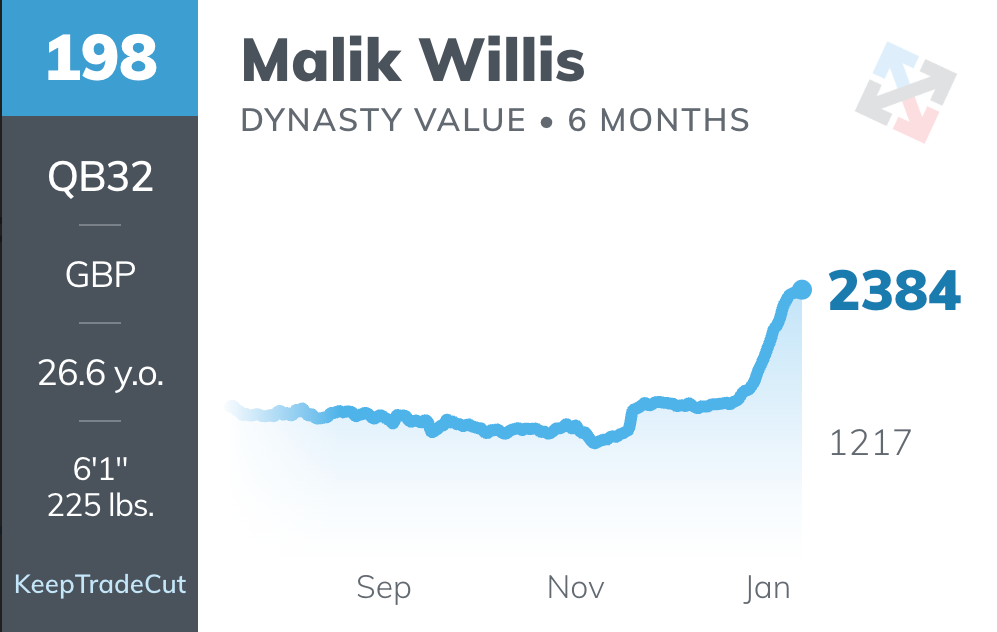
Malik Willis – QB, Green Bay Packers
Why He’s Cheap
This isn’t a true deep waiver stash everywhere, but in leagues where waivers closed before the end of the season, Willis can still be available. I’ve gotten multiple questions about FAAB, and depending on team build, 40–50% is defensible if you’re quarterback-needy or playing Superflex.
Market perception still lags behind reality:
Seen as a failed Titans experiment
Limited career pass attempts
Labeled a “backup” despite meaningful flashes
That gap between perception and performance is where the value lives.
Why He Matters
Over the past two seasons, Willis has flashed legitimate starter-level play in relief of an injured Jordan Love. Before suffering a right shoulder injury, he was flat-out productive.
2025 production (limited sample):
30-of-35 passing (85.7%)
422 passing yards
3 passing TDs, 0 INTs
123 rushing yards on 22 carries
2 rushing TDs
The advanced metrics back it up. Since the start of 2024 (minimum 100 dropbacks), Willis ranks first in EPA per dropback:
Malik Willis: 0.377
Josh Allen: 0.289
Jordan Love: 0.240
Brock Purdy: 0.235
Lamar Jackson: 0.227
That’s not noise — that’s efficiency at the highest level.
What changed in Green Bay? Time, structure, and coaching. Sitting in Matt LaFleur’s system allowed Willis to:
Slow the game down
Learn defensive reactions
Operate in a scheme that simplifies reads and maximizes athleticism
He’s still not a perfect passer — he’ll miss open receivers — but the rushing upside and system fit raise his floor significantly.
Paths to Value
Willis has multiple, realistic paths to dynasty relevance:
Injury: He’s already proven he can step in and produce when needed
Depth Chart Movement: Green Bay has shown trust, teams are noticing
Contract Situation: Likely to land a 2–3 year deal as a bridge starter
Scheme Fit: LaFleur-style systems minimize his weaknesses and amplify strengths
With a questionable 2026 QB class and several teams unlikely to pick in the top three, Willis profiles as an ideal solution for quarterback-needy franchises.
Dynasty Action
Buy as a throw-in / Add aggressively if available
From a dynasty lens, Willis profiles as a clear QB2 with upside. If he lands a starting role and follows a career arc similar to Sam Darnold or Baker Mayfield, you’re suddenly holding a meaningful, liquid asset in Superflex formats.
This is the exact type of stash you want:
Low cost
Multiple outs
Value insulated by positional scarcity
You don’t need him to be elite; you need him to start.
12 Team SF/TE Premium Dynasty Trades
Malik Willis FOR 2027 2nd
Malik Willis FOR DK Metcalf
Malik Willis FOR Brian Robinson/2026 3rd
Malik Willis FOR Juwan Johnson
Malik Willis FOR Tua Tagovailoa