


Rankings are never going to be perfect. That’s just the reality of dynasty and devy football. Player values are constantly changing, and as much as we want to be ahead of the market, sometimes we have to reevaluate what we’re seeing and make adjustments.
Over the past few days, I’ve spent a considerable amount of time going back through my combined dynasty and devy rankings. I’ve looked at player production, long-term outlooks, market values, and where I might be too high or too low on certain players. Some of these adjustments were long overdue, while others came down to changing how I view a player’s future.
One thing I’ve always believed is that you can’t get too attached to your rankings. Just because you were high on a player six months ago doesn’t mean you have to keep him there. The same goes for players you might have been lower on. Sometimes you have to admit you were wrong, adjust, and move forward. That’s part of the process.
With that being said, we recently completed a full audit of our dynasty and devy rankings over at The Devy Royale. While I’m only going to highlight eight players in this article, we’ve made adjustments throughout our rankings. If you haven’t checked them out recently, I encourage you to head over to the website and take a look.
And the rankings are just one piece of what we’re building at TDR. Along with our updated dynasty, devy, C2C, and CFF rankings, subscribers have access to our Trade Calculator, Dynasty Investor, player projections, Player Comps, Red Flags, Devy Draft Simulator, depth charts, recruiting tools, and much more. We also continue to put out articles throughout the week covering dynasty strategy, devy prospects, player evaluations, waiver wire targets, and the ever-changing fantasy football landscape. Our goal is to give you as many tools and resources as possible to help you make informed decisions about your rosters.
For today’s article, though, I wanted to narrow things down and highlight eight players who saw some notable movement in my latest update. We’ll look at two dynasty risers, two devy risers, and four players moving in the opposite direction.
Let’s get into it.
Dynasty Risers
Isaiah Likely, TE, New York Giants
Previous Ranking: No. 218 Overall | Updated Ranking: No. 104 Overall (↑114)
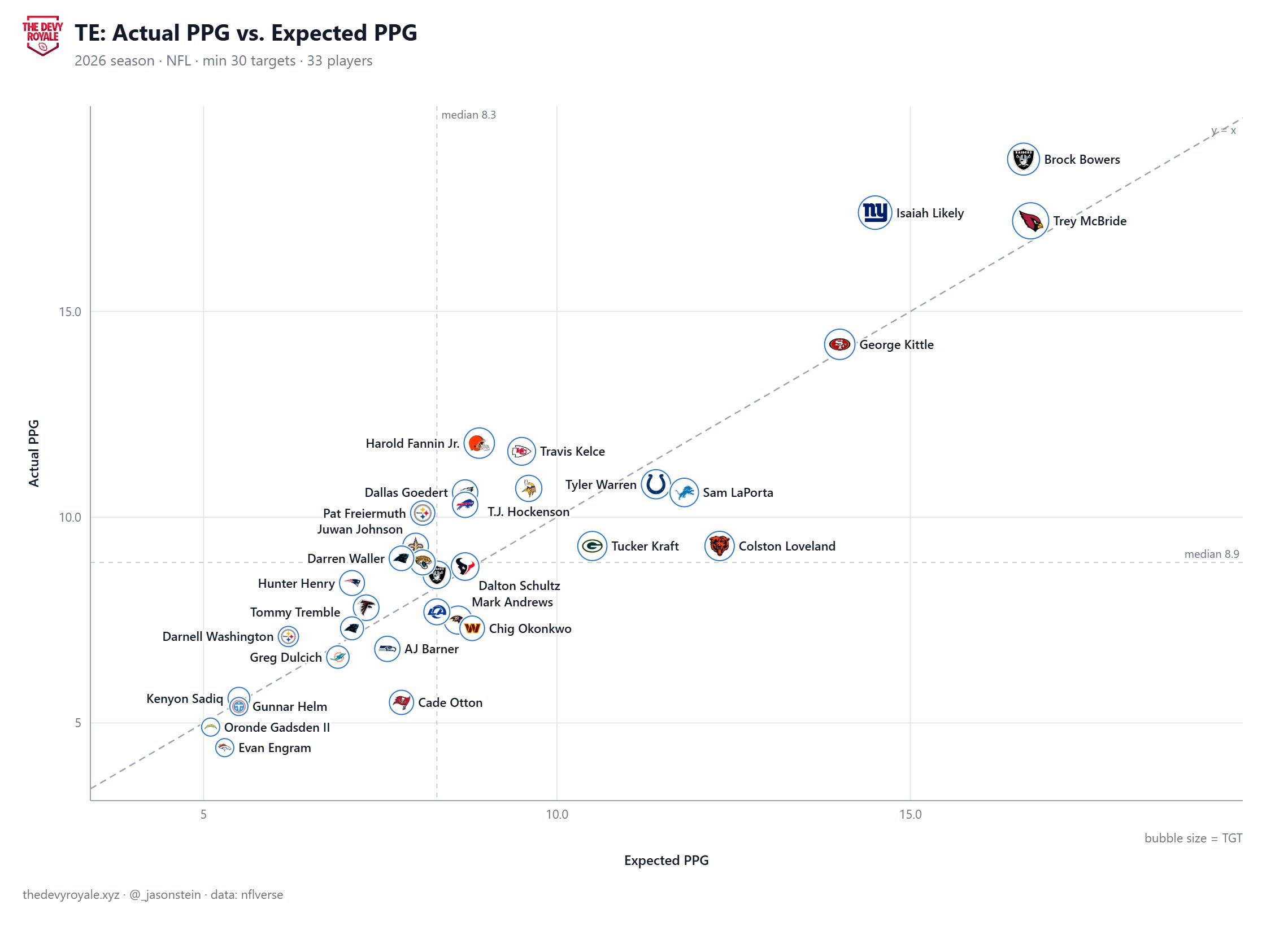
I was simply too low on Likely. There’s really no other way to put it. We’ve always known the talent was there, but the question was what his fantasy ceiling would look like once he got out from behind Mark Andrews. Through nine games in New York, I think we have our answer.
Likely has emerged as one of the most productive tight ends in football, hauling in 55 receptions for 575 yards and seven touchdowns, averaging 17.4 PPR points per game. He’s currently the TE3 on the season and has already posted four games with over 23 PPR points. His most recent performance against Washington was another reminder of what he’s capable of, finishing with nine receptions for 127 yards and a touchdown on 11 targets.
What really stands out to me isn’t necessarily the production, though. It’s the usage. Likely is commanding a 26.5% target share and a 28% first-read target share, numbers that put him among the elite players at the position. This isn’t a tight end relying on touchdown efficiency or a handful of designed plays to produce fantasy points. He’s becoming a legitimate focal point of the Giants’ passing attack.
From a dynasty perspective, that’s where things get interesting. Likely is still just 26 years old, he’s tied to New York on a three-year contract, and we’re finally getting an extended look at what he can do as the primary tight end. There aren’t many players at this position who offer his combination of age, opportunity, and weekly upside.
I’ve moved Likely up 114 spots to No. 104 overall, and I still think there’s an argument to be made that I’m not quite high enough. The dynasty market has already started adjusting, with KeepTradeCut valuing him as a top-five tight end. The bigger question for me is whether he belongs in that next tier behind Brock Bowers and Trey McBride, or if he’s legitimately pushing his way into the top-three conversation.
I’m not ready to put him ahead of those two, but the gap is closing. When you’re getting this type of target volume from a 26-year-old tight end with a secure role, you have to take notice. The days of treating Isaiah Likely as a speculative dynasty asset are over. He’s established himself as a legitimate cornerstone at the position, and my rankings needed to reflect that.
Bhayshul Tuten, RB, Jacksonville Jaguars
Previous Ranking: No. 190 Overall | Updated Ranking: No. 100 Overall (↑90)
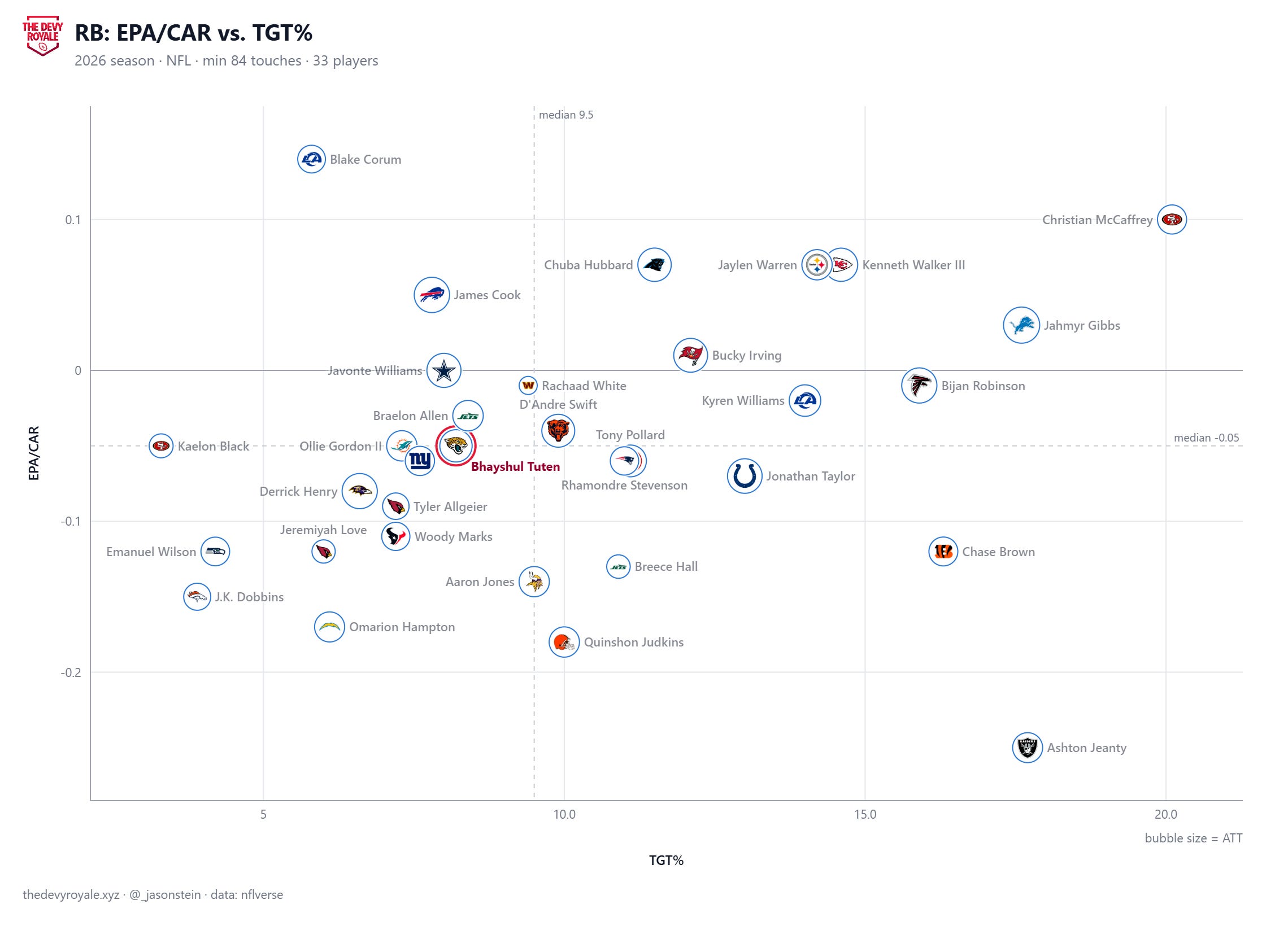
I was actually pretty high on Bhayshul Tuten coming into the season. I loved his value throughout the offseason and thought he was one of the better running back investments you could make in dynasty. The talent was there, the athletic profile was intriguing, and with Travis Etienne departing for New Orleans, I thought there was a legitimate opportunity for Tuten to take control of this backfield. The biggest question was whether Jacksonville would give him that opportunity or turn this into a committee.
Through nine games, I think we have our answer.
Tuten has emerged as the clear lead back in Jacksonville, totaling 609 rushing yards, 206 receiving yards, and eight touchdowns while averaging 16.4 PPR points per game. He’s currently the RB13 on the season and has been even better recently, averaging 20.3 PPR points over his last four games.
What has impressed me most is how his role has evolved. We knew about the explosiveness and his 4.32 speed coming out of Virginia Tech, but there were legitimate concerns about whether he could handle a full workload at the NFL level. Those concerns haven’t completely disappeared, but Jacksonville is certainly showing confidence in him. In Week 10, Tuten handled 26 carries compared to just four for Chris Rodriguez, played 71% of the offensive snaps, and received 11 red-zone carries. That’s the type of usage we want to see from a running back we’re investing in for dynasty.
From a dynasty perspective, Tuten is becoming an extremely interesting asset. He’s just 23 years old, playing in a productive Jacksonville offense, and appears to have established himself as the long-term answer at running back. The biggest knock on him entering the league was his fourth-round draft capital, and that’s still something we have to consider. Day 3 running backs don’t always have the same job security as players with premium draft capital. However, at some point, production and opportunity have to outweigh where a player was selected.
I’ve moved Tuten up 90 spots to No. 100 overall, which is a significant adjustment. The dynasty market has been even more aggressive, with KeepTradeCut now valuing him as a top-10 dynasty running back. I’m not quite ready to go that far, but I certainly understand the argument.
The frustrating part is that the buying window has probably already closed. Tuten was someone I was targeting throughout the offseason because I thought his acquisition cost was well below his potential ceiling. That value has largely disappeared as the market has caught up to his production.
I still like Tuten quite a bit as a dynasty asset, but there’s a difference between liking a player and liking the price you’re paying to acquire him. At his current market value, I’m probably not going out of my way to buy him. If I already have him on my roster, though, I’m more than comfortable holding and seeing just how high his value can climb.
Dynasty Fallers
Josh Jacobs, RB, Green Bay Packers
Previous Ranking: No. 106 Overall | Updated Ranking: No. 175 Overall (↓69)
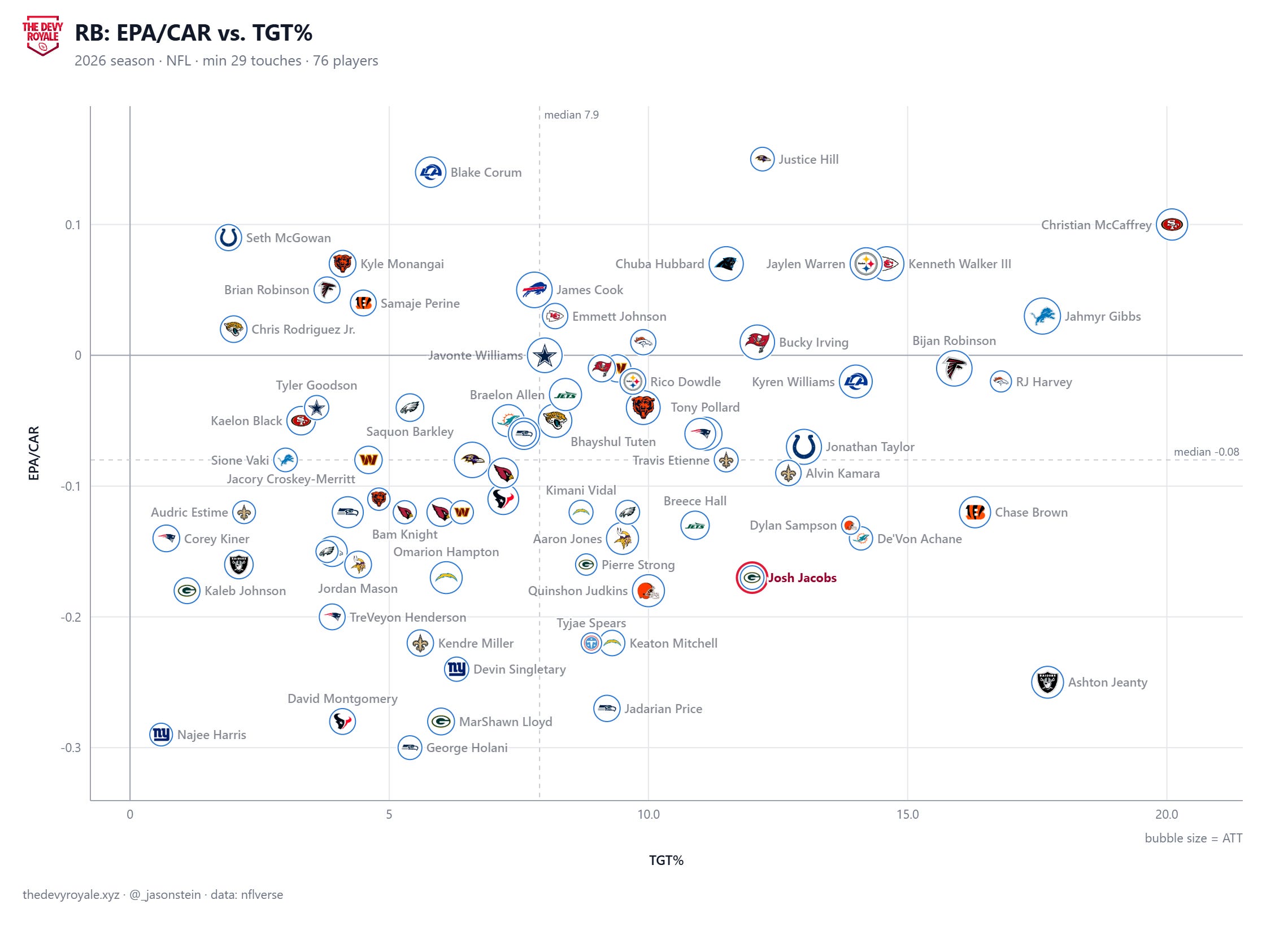
Josh Jacobs is one of those players who perfectly illustrates the difference between fantasy production and dynasty value. When he’s on the field, he’s still capable of putting up fantasy points. The problem is everything else surrounding him right now, and at some point, you have to start factoring that into his long-term outlook.
It’s been a difficult 2026 season for Jacobs, both on and off the field. Between his off-field legal issues, six games on the Commissioner’s Exempt List, and now a fractured finger that required surgery, he’s barely been available for Green Bay. He’s appeared in just three games this season, and with Jacobs approaching 29 years old, the concerns are starting to pile up.
The frustrating part is that even when Jacobs has played, the efficiency hasn’t been there. In Weeks 7 and 8, he carried the ball 32 times for just 75 yards, averaging a little over 2.3 yards per carry. That’s not exactly encouraging for a running back with nearly 1,900 career carries. However, he still managed to produce 15.1 and 17.2 PPR points in those two games because of his receiving involvement and ability to find the end zone.
That’s what makes Jacobs such an interesting dynasty asset right now. The fantasy production is still there when he’s healthy, but how much longer can we realistically count on it? He’s getting older, the mileage is adding up, and his dynasty value continues to decline. The emergence of other options in Green Bay’s backfield only adds another layer of uncertainty.
I’ve moved Jacobs down 69 spots to No. 175 overall, and this is less about whether I think he can still help a fantasy lineup and more about what I’m willing to invest in him moving forward. In dynasty, availability, age, and long-term job security matter just as much as what a player can do on any given Sunday.
For a contending roster, Jacobs still makes sense as a player who can provide production when healthy. I’m not suggesting you need to sell him for whatever you can get. However, for rebuilding teams, I think the window to maximize his value has already passed, and I’d be looking to move him if there’s still a manager willing to pay for his past production.
Jacobs can still score fantasy points. I don’t think that’s the question. The question is whether his remaining production is worth the risk you’re taking on as a dynasty manager. At this stage of his career, I’m becoming less comfortable making that bet.
Lamar Jackson, QB, Baltimore Ravens
Previous Ranking: No. 4 Overall | Updated Ranking: No. 14 Overall (↓10)
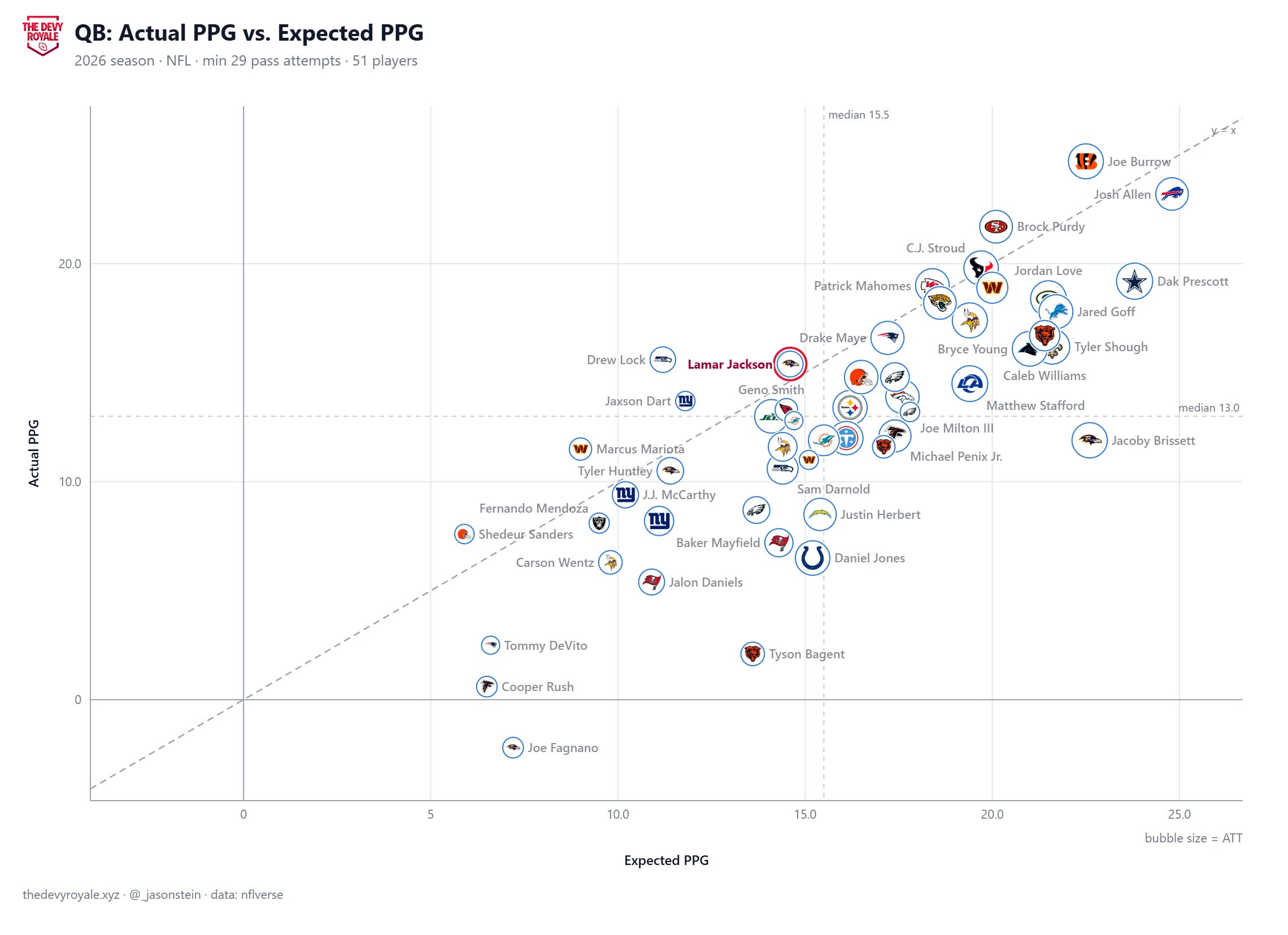
Lamar Jackson is probably going to be one of my more controversial rankings adjustments, but I’ve moved him down ten spots from No. 4 to No. 14 overall. I understand the argument for buying low on Lamar right now. He’s still one of the most talented quarterbacks in football, and we’ve seen what he’s capable of when everything is clicking. However, I actually think buying low on Lamar is a mistake. In fact, I still view him as a sell in dynasty.
My concern isn’t necessarily whether Lamar can still be an elite fantasy quarterback. Of course he can. We’ve seen him put up league-winning numbers, and his rushing ability gives him a ceiling that very few quarterbacks can match. The bigger question for me is how much longer we can realistically expect that type of production, especially when so much of his fantasy value is tied to his legs.
Lamar is approaching 30 years old, and while that’s not particularly old for a quarterback, it’s a different conversation when we’re talking about someone who relies so heavily on his athleticism. We’ve already seen injuries become part of the equation throughout his career, and I think dynasty managers need to start considering what his fantasy profile looks like when that rushing production eventually declines.
The other issue is his dynasty valuation. Even with the concerns surrounding him, Lamar still carries significant name recognition and trade value. There are managers who look at his past production and see an opportunity to acquire an elite quarterback at a discount. I look at the situation a little differently. Just because a player’s value has declined doesn’t automatically mean he’s a buy-low candidate. Sometimes the market is adjusting to legitimate concerns about a player’s long-term outlook.
That’s where I think we are with Lamar.
I’ve moved him to No. 14 overall, and I still think there’s an opportunity to capitalize on his remaining dynasty value. If I’m rebuilding, I’m actively shopping him. If I’m contending, I’m not necessarily forcing a trade, but I’m absolutely willing to move him if someone is willing to pay for the possibility of another elite fantasy season.
The key is understanding that you don’t have to wait until a player completely falls off to move on. In dynasty, some of the best trades you can make involve getting out of an asset while the rest of the market still believes there’s more value to be had.
I’m not saying Lamar Jackson is finished. I’m saying I don’t want to be the manager holding him when his dynasty value takes another significant hit. At his current price, I’d much rather be the one selling the upside than paying for it.
Devy Risers
Jesse Legree, WR, Oregon State
Previous Ranking: No. 203 Overall | Updated Ranking: No. 147 Overall (↑56)
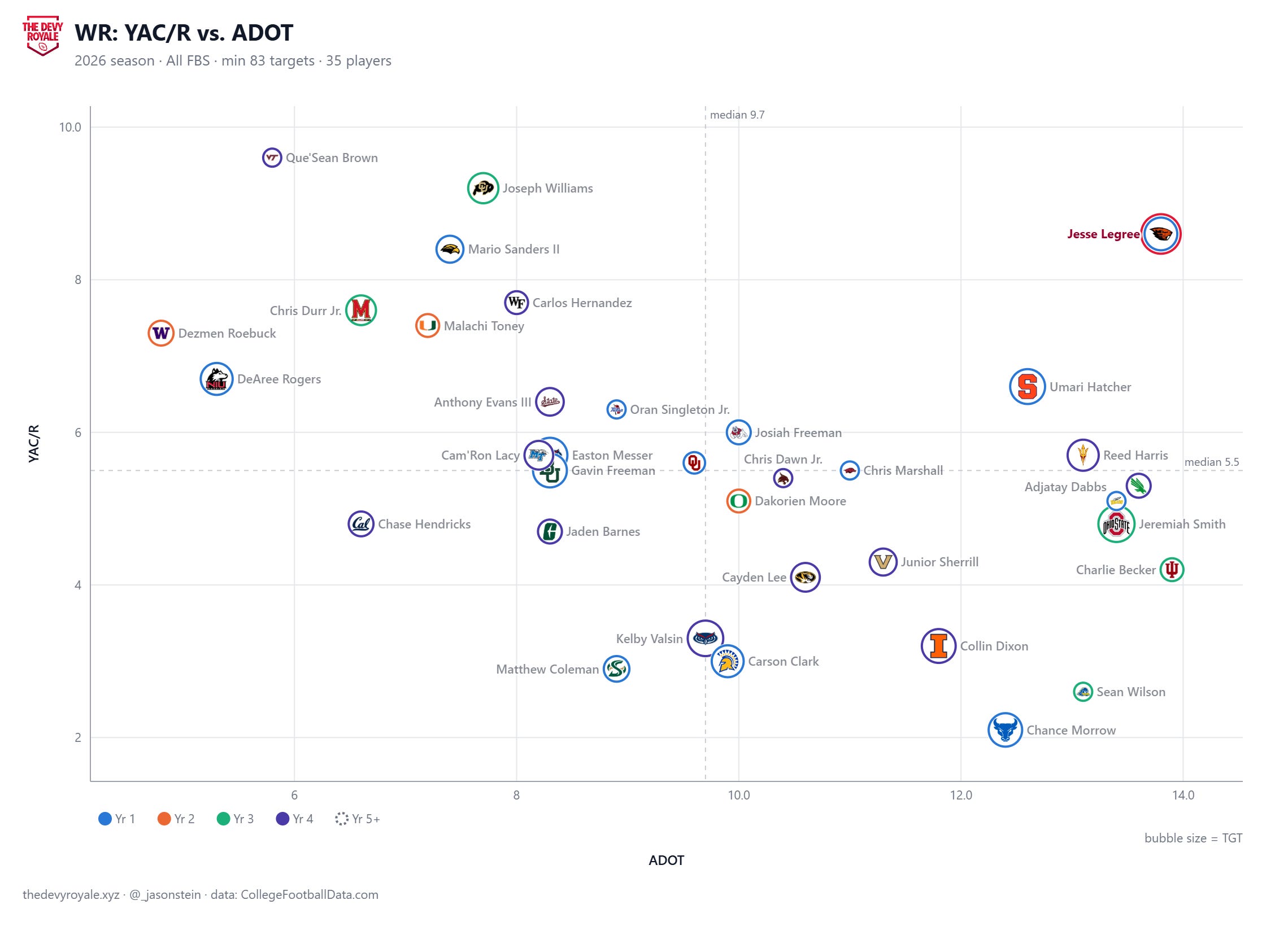
At some point, you have to stop questioning whether a player is legitimate and start recognizing what he’s accomplishing. That’s where I’m at with Jesse Legree. I’ve moved the Oregon State freshman up 56 spots in my combined rankings, and quite frankly, I’m starting to wonder if that’s enough.
Legree has been one of the biggest surprises in college football this season. We’re talking about a former three-star recruit who barely received any attention during the recruiting process and has somehow turned himself into one of the most productive wide receivers in the country. Through ten games, he’s hauled in 73 receptions for 1,349 yards and 15 touchdowns, averaging an absurd 134.9 receiving yards per game. He’s also put together eight 100-yard performances and earned recognition as a Biletnikoff Award semifinalist. That’s remarkable production for any player, let alone a true freshman.
What makes Legree’s emergence so interesting from a devy perspective is his age-adjusted production. I’m always looking for young players who can establish themselves early in their college careers, and Legree has done considerably more than that. He’s not simply contributing as a freshman. He’s dominating. The production is difficult to ignore, especially when you consider how quickly he’s become the focal point of Oregon State’s passing attack.
There are still legitimate concerns about his long-term NFL projection. At 5-foot-10 and 172 pounds, Legree doesn’t have the prototypical size we’re accustomed to seeing from highly valued NFL wide receiver prospects. He’s also playing at Oregon State, which means questions about competition and how his game will translate against NFL-caliber defensive backs are fair. Those are things I’m going to continue monitoring as his college career progresses.
From a dynasty and devy standpoint, though, I think the bigger mistake would be continuing to discount what he’s already shown us. He’s producing at a historic level as a true freshman, and that type of early breakout is exactly what we should be targeting in devy leagues. The fact that he’s not eligible for the NFL Draft until 2029 creates some additional risk, but that’s also where the potential value comes into play if you’re willing to be patient.
I’ve moved Legree from No. 203 to No. 147 overall, and he’s quickly becoming one of the more intriguing young assets in my rankings. KeepTradeCut already has him inside its top 15 overall devy players, so the market has clearly taken notice. I’m not quite ready to push him that aggressively in a combined dynasty and devy format, but his trajectory certainly warrants a significant adjustment.
I’m not ready to crown Jesse Legree as a future NFL superstar after ten college games. However, when a true freshman is producing at this level, you have to take notice. His dynasty value is only going to continue climbing if he maintains anything close to this production, and I’d rather adjust now than spend the next year trying to catch up.
J.J. Buchanan, WR, Michigan
Previous Ranking: No. 451 Overall | Updated Ranking: No. 138 Overall (↑313)
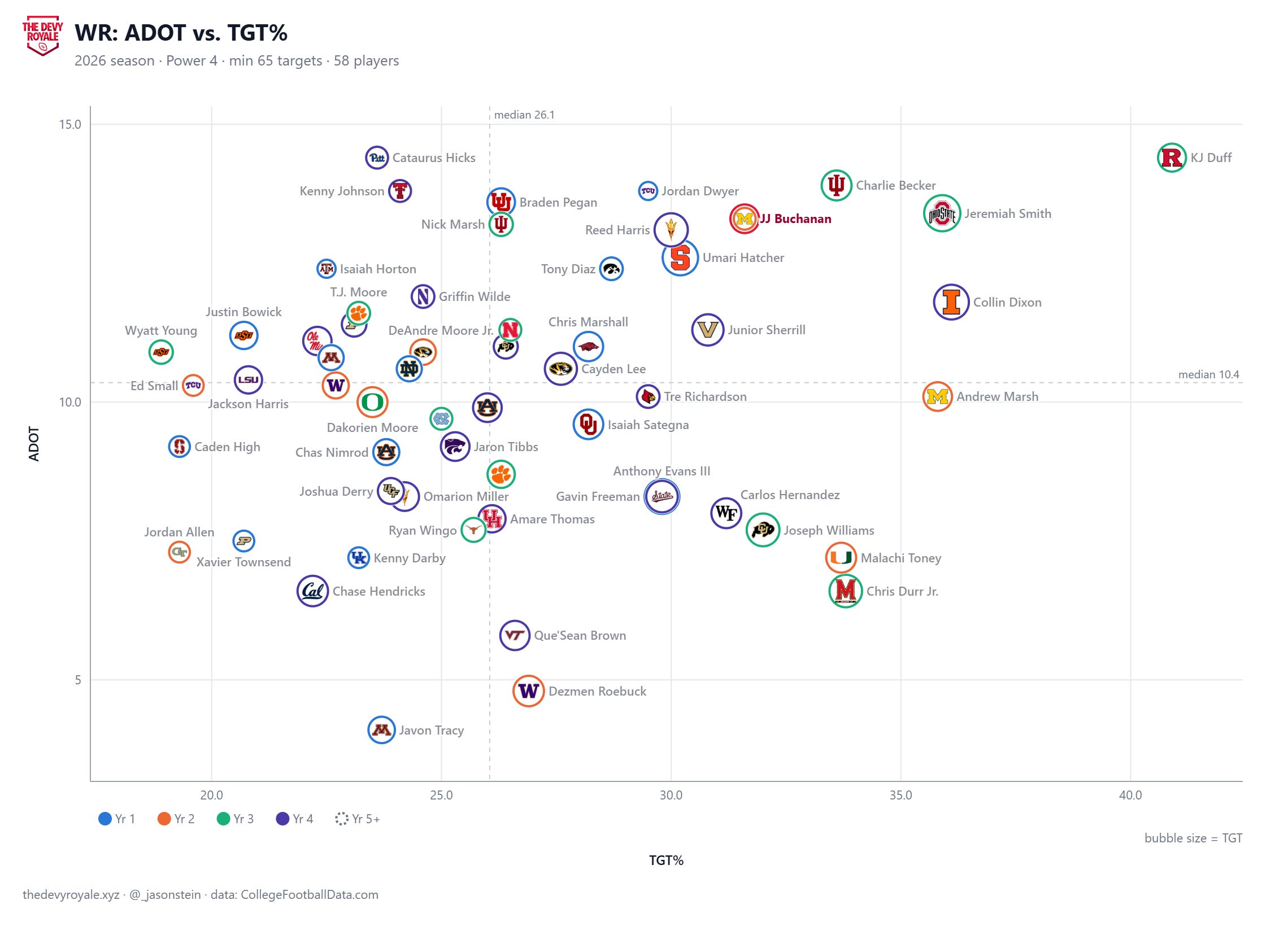
J.J. Buchanan might be one of the more overlooked wide receiver prospects in college football, and quite frankly, I was way too low on him. I’ve moved the Michigan sophomore up 313 spots in my combined rankings, which is one of the largest adjustments I’ve made during this audit. The more I look at what Buchanan has accomplished this season, the more impressed I am, especially considering the circumstances surrounding him.
Michigan’s passing offense has been an absolute disaster this season. The Wolverines are averaging just 163.6 passing yards per game, ranking 128th nationally, and have struggled to generate any consistency through the air. Despite all of that, Buchanan has managed to produce 40 receptions for 646 yards and five touchdowns, accounting for nearly 40% of Michigan’s receiving yards and over 70% of its receiving touchdowns.
Think about that for a second. Michigan has thrown just seven touchdown passes all season, and Buchanan has caught five of them. That’s an absurd level of production relative to his offense, and it’s something I think gets overlooked when evaluating college prospects. What makes Buchanan particularly intriguing is his physical profile. At 6-foot-4 and 218 pounds, he has the size and athleticism NFL teams covet at the position. He actually began his college career as a tight end at Utah, where he led all freshman tight ends with 427 receiving yards and five touchdowns before following Kyle Whittingham to Michigan and transitioning to wide receiver. That versatility, combined with his ability to win downfield and make contested catches, gives him an interesting NFL projection.
The underlying numbers are encouraging as well. Buchanan earned an 85.7 PFF receiving grade, averaged 16.2 yards per reception, and didn’t record a single drop on 70 targets. Those are impressive numbers for someone playing in an offense that has struggled as much as Michigan’s. Unfortunately, Buchanan suffered a season-ending shoulder injury against Oregon, which adds some uncertainty to his outlook heading into 2027. However, from a devy perspective, I’m much more interested in what he’s already demonstrated than the immediate impact of the injury, assuming he makes a full recovery.
I’ve moved Buchanan from No. 451 to No. 138 overall, and I think there’s still room for him to climb. He’s eligible for the 2028 NFL Draft, and I wouldn’t be surprised if we’re discussing him as one of the better wide receiver prospects in that class a year from now. The biggest takeaway for me is that we can’t evaluate devy prospects strictly on their raw production without considering the environment they’re playing in. Buchanan isn’t putting up the ridiculous numbers we’re seeing from Jesse Legree, but he’s commanding an enormous share of an offense that simply cannot throw the football consistently.
From a dynasty standpoint, that’s exactly the type of player I’m interested in identifying before the rest of the market catches up. If Michigan can figure out its quarterback situation and improve offensively next season, Buchanan’s value could increase substantially. I’m buying into the talent, the physical profile, and the underlying production. The situation has been terrible, but Buchanan has been anything but.
Devy Fallers
Harlem Berry, RB, LSU
Previous Ranking: No. 138 Overall | Updated Ranking: No. 298 Overall (↓160)
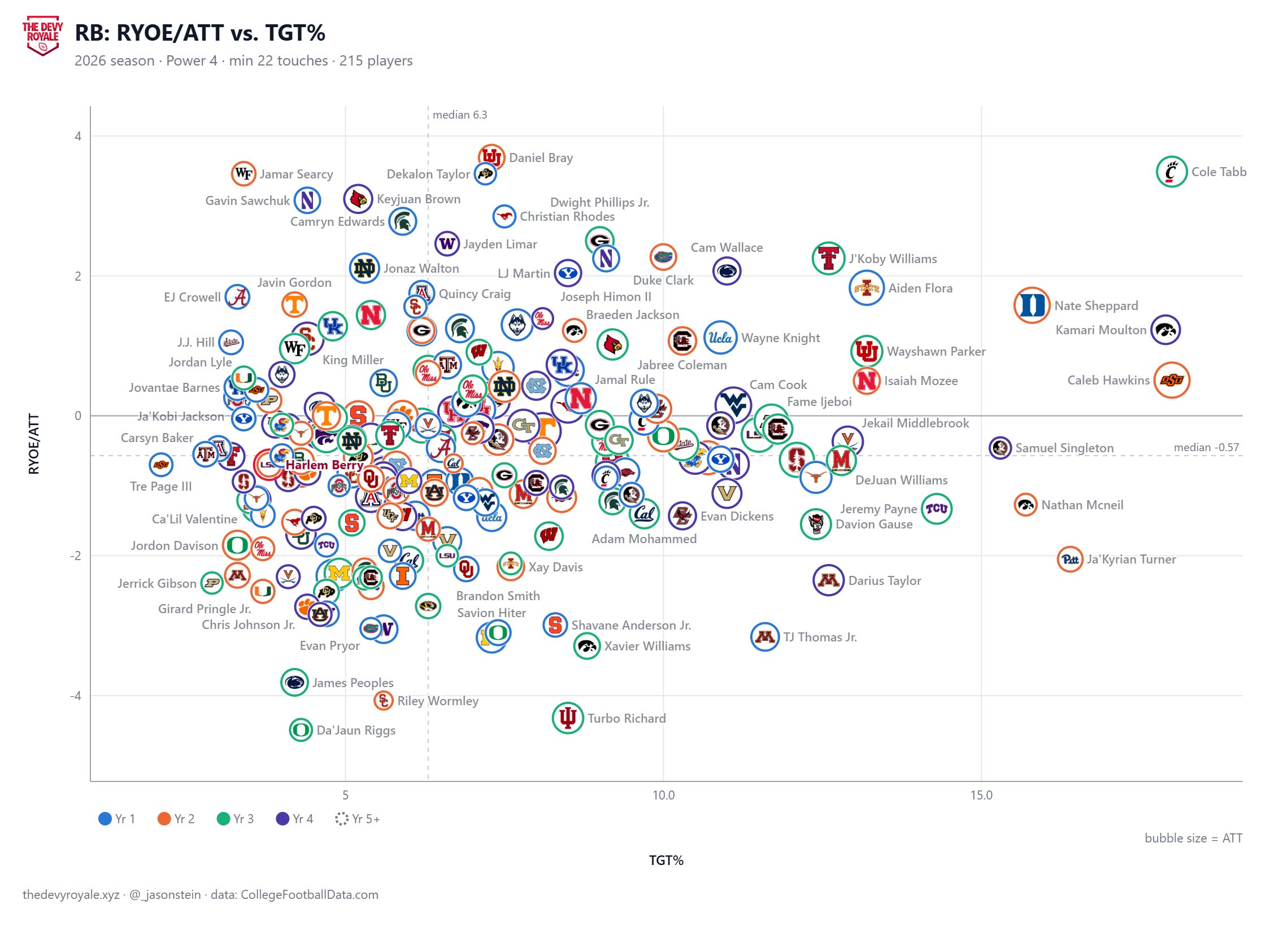
Harlem Berry was a miss by me. There’s really no other way to put it. I was incredibly high on Berry coming out of high school, and I thought he had the talent to develop into one of the better running backs in the 2028 NFL Draft class. The recruiting pedigree was there, the athleticism was exciting, and I expected him to eventually become a significant part of LSU’s offense. Unfortunately, we’re now two years into his college career, and I’m starting to question whether that’s ever going to happen.
Berry has been almost nonexistent in LSU’s offense this season. Through ten games, he’s carried the ball just 32 times for 202 yards and one touchdown. Even more concerning is that 125 of those yards came against McNeese State. Outside of that performance, he’s managed just 77 rushing yards all season. For a player who entered college as the nation’s top-ranked running back recruit, that’s an incredibly disappointing development.
The arrival of Lane Kiffin hasn’t helped matters. Wisconsin transfer Dilin Jones has taken control of the backfield, and Berry has essentially become an afterthought. There have been questions surrounding his pass protection and ability to consistently run between the tackles, and those are legitimate concerns when projecting him to the NFL level. What bothers me most isn’t necessarily the lack of production. It’s the lack of opportunity. We’re talking about a player who was supposed to be one of the most talented running backs in his recruiting class, yet he can’t consistently get on the field. At some point, we have to stop leaning on recruiting rankings and start evaluating what a player is actually showing us.
I honestly wouldn’t be surprised if this is Berry’s last season at LSU. A transfer feels increasingly likely, and I wouldn’t rule out him eventually landing at a Group of Five program where he can get consistent touches and attempt to rebuild his draft stock. That would have been almost unthinkable when he arrived in Baton Rouge, but that’s where we’re at right now. From a devy perspective, this is exactly why investing heavily in young running backs can be so dangerous. I was banking on Berry’s talent eventually translating into production, and that simply hasn’t happened. He’s still only 19 years old, so I’m not completely writing him off, but the likelihood of him developing into the high-end NFL prospect I originally envisioned has certainly decreased.
I’ve moved Berry down 160 spots from No. 138 to No. 298 overall, and quite frankly, I probably held onto his value longer than I should have. There’s still some athletic upside here, but I’m no longer willing to rank him based on what I thought he could become two years ago. This is one of those evaluations where I got too attached to the recruiting profile and didn’t adjust quickly enough when the situation changed. Berry could still turn things around somewhere else, but from a devy standpoint, I’m not interested in paying for the player we thought he was going to be. At this point, he needs to prove it on the field before I’m willing to invest in him again.
Justice Haynes, RB, Georgia Tech
Previous Ranking: No. 137 Overall | Updated Ranking: No. 229 Overall (↓92)
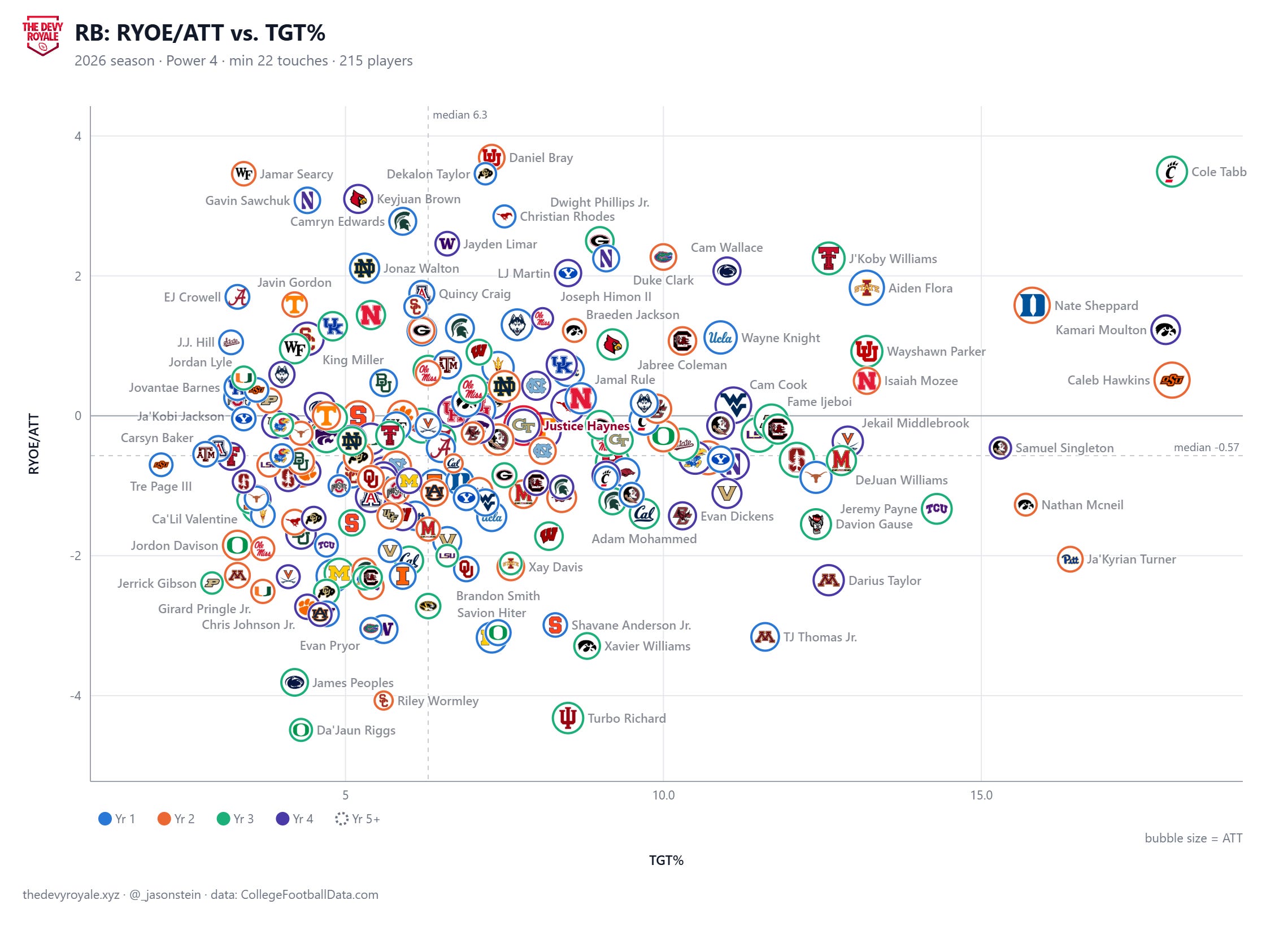
Justice Haynes is another running back I’ve had to reevaluate over the past few months. Coming into the season, I was pretty optimistic about his NFL outlook, especially after what we saw from him at Michigan in 2025. The talent was there, the production was impressive, and I thought he had a legitimate opportunity to establish himself as one of the top running backs in the 2027 NFL Draft class. Unfortunately, things haven’t exactly gone according to plan.
Haynes has rushed for 751 yards and five touchdowns on 137 carries, averaging 5.5 yards per attempt through nine games at Georgia Tech. Those aren’t terrible numbers by any means, especially considering the situation he’s playing in. Georgia Tech’s offense has struggled throughout the season, and Haynes hasn’t exactly had much help up front. He actually looked pretty good this past weekend against Clemson, rushing for 116 yards and a touchdown in the Yellow Jackets’ upset victory.
My concerns with Haynes go beyond his production, though. When he transferred to Michigan last season, he looked like a potential difference-maker, rushing for 857 yards and ten touchdowns in just seven games before suffering a season-ending foot injury. I expected him to build on that performance this year, but instead, we’ve seen a noticeable step backward in both his production and NFL Draft outlook. From a devy perspective, the biggest issue for me is his projected draft capital. At one point, I thought Haynes had a legitimate opportunity to become a Day 2 selection, potentially putting him in a position to compete for an NFL starting job relatively early in his career. Now, there are projections placing him somewhere on Day 3, and that’s a significant difference when we’re talking about long-term running back value.
There are still things I like about his game. Haynes has excellent contact balance, runs with good power for his size, and has forced 43 missed tackles while averaging 4.2 yards after contact per attempt this season. He’s clearly capable of creating yards on his own, which is important considering the offensive line he’s playing behind. However, I also have questions about his overall NFL ceiling. He’s played at three different programs in four years, has an injury history, and hasn’t shown much as a receiver, recording just 15 receptions this season. None of those things individually eliminate him as a legitimate NFL prospect, but collectively, they make me less confident in projecting him as a future three-down back.
I’ve moved Haynes down 92 spots from No. 137 to No. 229 overall, and I think that’s a more appropriate valuation given where things currently stand. I still believe there’s an NFL-caliber running back here, and I wouldn’t be surprised if he eventually finds a productive role at the next level. I’m just no longer comfortable investing in him as if he’s a future featured back. This is another example of why draft capital matters so much when evaluating devy running backs. I can like Haynes as a player while recognizing that his dynasty outlook isn’t nearly as strong as I thought it would be six months ago. If he ends up being selected earlier than expected, I’ll happily revisit his ranking. For now, I’m taking a more conservative approach.
Final Thoughts
Rankings are always going to be a work in progress. The dynasty and devy landscape changes constantly, and if you’re not willing to adjust your evaluations, you’re going to fall behind. Some of these moves were long overdue, while others reflect how my outlook on certain players has changed throughout the season. The important thing is recognizing those changes and making the necessary adjustments rather than holding onto previous evaluations.
These eight players are just a small sample of the changes we’ve made during our latest rankings audit. We currently have over 1,000 dynasty and devy players ranked on The Devy Royale, giving you a comprehensive look at player values across both the NFL and college football landscape.
Our Combined Dynasty & Devy Rankings allow you to compare established NFL players with college prospects all in one place. Whether you’re rebuilding, contending, or trying to figure out how to value your devy assets against proven NFL talent, our goal is to give you the resources to make informed roster decisions.
Check out our updated Combined Dynasty & Devy Rankings here!
As always, I appreciate everyone who continues to support what we’re building at TDR. We’ll continue updating these rankings as new information becomes available, and I’m sure there will be plenty more movement as we get closer to the end of the season.