


Dynasty startups are never as simple as just taking the highest-ranked player on the board.
Every round creates a different type of decision. Early on, you are trying to decide between elite positional value, youth, and long-term insulation. In the middle rounds, you start weighing production against upside. Later in drafts, it becomes about finding pockets of value before the market catches up.
For this article, we are using 12-team Superflex, TE Premium ADP from Dynasty Data Lab to look at some of the tougher decisions managers are currently facing in startup drafts. The goal is not to compare the same group of obvious names everyone already talks about. Instead, I wanted to pull out unique on-the-clock decisions from each round and talk through where I would lean.
Some of these calls are going to come down to roster construction. Some are going to come down to market value. And some are simply going to be about conviction. That is what makes dynasty startups so fun and so difficult at the same time.
So, round by round, let’s look at a tough dynasty startup decision, why it is close, and where I would go if I were on the clock.
1st Round
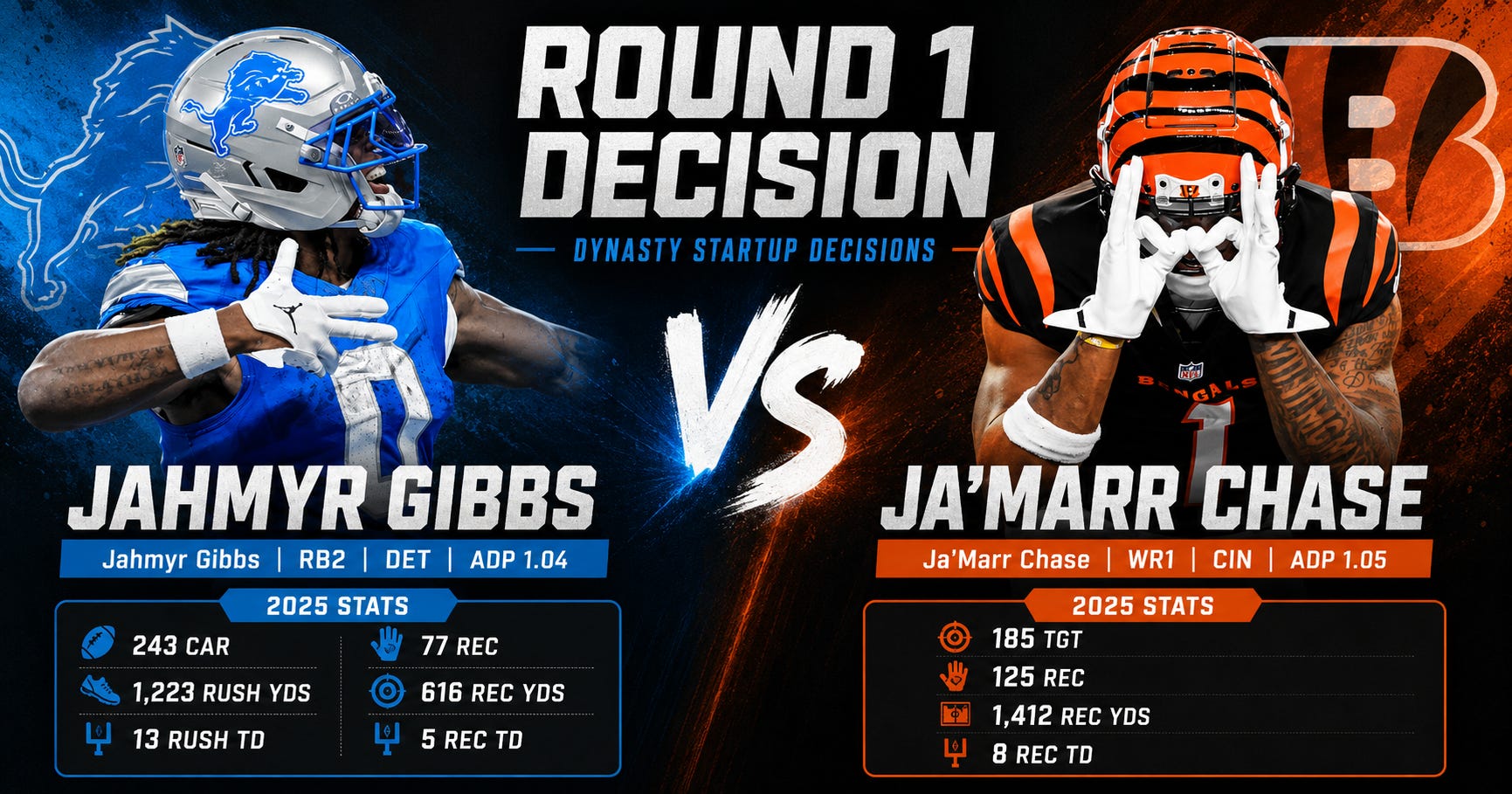
This is the kind of decision that makes the first round of a dynasty startup so difficult. There really is not a wrong answer here.
Jahmyr Gibbs and Ja’Marr Chase are both elite dynasty assets. They are difference-makers. They are young enough to still hold long-term value, productive enough to help you win now, and insulated enough where you feel good building around either one. This is a win-win decision.
Chase is special. Since entering the league, he has been one of the safest elite wide receiver bets in fantasy football. When Joe Burrow is healthy, Chase is arguably the best wide receiver in the game. The volume is ridiculous. Since 2024, no player in football has seen more targets or run more routes. He has already proven he can carry elite fantasy production year after year, and even when Burrow has missed time, Chase has still remained productive.
The Bengals continue to be one of the most pass-heavy offenses in football, and that matters. Chase is not just an elite talent. He is attached to the exact type of offensive environment we want. He has the target volume, the quarterback, the weekly ceiling, and the long-term market value. Taking Chase here is never something I would push back on.
But I lean Gibbs.
The reason is simple: true difference-makers at running back are harder to find.
The elite wide receiver tier after Chase is still strong. You can make a case that the next group of receivers is closer to Chase than the next group of running backs is to Gibbs. That is where this decision starts to tilt for me. In dynasty, we have become so conditioned to chase wide receiver value that sometimes we forget how big of an advantage an elite running back can still be.
Gibbs has been one of the most explosive players in football through the first three years of his career. He has been a home-run hitter, a tackle-breaker, a receiving weapon, and one of the most efficient backs in the league. Now the workload ceiling appears to be changing. With David Montgomery out of the way, Dan Campbell has already called Gibbs their bell cow. That matters.
This was always the one thing holding Gibbs back from being viewed in that untouchable fantasy running back tier. It was never the talent. It was never the offense. It was never the efficiency. It was the fact that Montgomery was always there to cap the weekly touch ceiling.
That cap may be gone now.
Detroit remains one of the best running back environments in football. The offensive line is strong, the offense scores points, Jared Goff is not stealing rushing production, and this system consistently creates easy touches for backs. Gibbs has already shown he can be elite on a limited workload. If he pushes into that 300-touch range, the ceiling is outrageous.
I also think “bully RB” is still a very real dynasty startup strategy when you are landing the right type of running back. I am not talking about chasing replaceable volume backs. I am talking about locking in a player who can break fantasy weeks and give your roster a weekly advantage that is hard to recreate later.
Chase is the safer dynasty archetype. He is the elite wide receiver with long-term insulation. I get it. But Gibbs gives me the positional hammer. When I look at the board, I feel better about the wide receivers I can find after Chase than the running backs I can find after Gibbs. That is the tiebreaker.
Lean: Jahmyr Gibbs
2nd Round
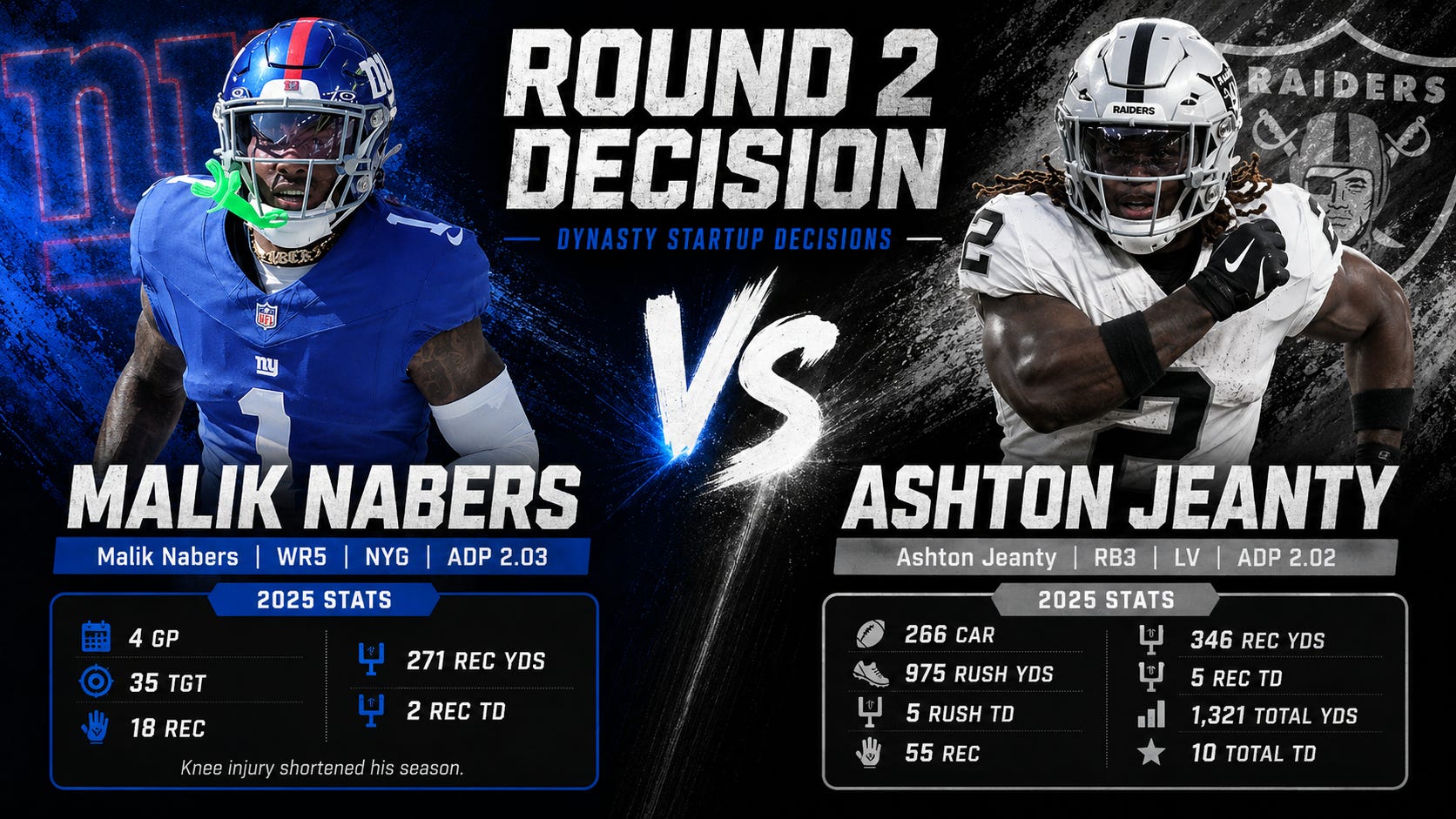
This is another one where I understand both sides, but the injury context really changes the conversation for me.
Malik Nabers is still one of the best young wide receivers in dynasty. Nothing about the injury changes the talent. Nothing about it changes the prospect profile. Nothing about it changes what he showed as a rookie when he looked like a future cornerstone fantasy asset. If you are rebuilding or reloading, Nabers is still exactly the type of player I want to be targeting.
But in a startup, especially when we are talking about the second round, I have to factor in the full picture. The knee injury is a real concern. This was not described as a simple ACL situation. The meniscus involvement, the cleanup surgery, and the way people have talked about his rehab make it hard for me to just brush it off. There is a very real chance Nabers starts slow, misses early time, opens the year on PUP, or needs a long ramp-up before he looks like himself again.
That matters.
When you are spending a premium startup pick, that player is supposed to be one of the foundations of your roster. If I am trying to contend right away, I do not love the idea of using a second-round pick on a wide receiver who may not give me elite production until late in the season, or possibly until 2027. I hope I am wrong on that, because Nabers is special, but it has to be part of the decision. The other part of this is positional depth. Wide receiver is still deep. It is not easy to replace Nabers, but you can find strong receivers later. You can build around other productive young wideouts. You can tier down and still feel good about the direction of your roster.
Running back is different. Ashton Jeanty was not perfect as a rookie. The raw numbers were solid, but the week-to-week production was uneven. He finished with 266 carries, 975 rushing yards, 55 catches, 346 receiving yards, and 10 total touchdowns. That is a strong season, but it was not always smooth. He had too many games where the efficiency was not there, and the Raiders offense did him very few favors.
The offensive environment was rough. The Raiders were near the bottom of the league in yards, plays, scoring, run blocking, and adjusted line yards. Jeanty was constantly being hit before he had a real runway. So when you see the yards per carry and the efficiency metrics, I think you have to add context. Some of that was on him, but a lot of it was on the offense around him.
What keeps me interested is the usage.
Jeanty walked into the league and was immediately treated like a feature back. He ranked near the top of the league in carry share, snap share, red-zone carry share, and inside-the-10 usage. That is not easy to find. The Raiders drafted him sixth overall, gave him a massive workload, and everything coming into 2026 points toward him remaining the centerpiece of that backfield.
The offensive line should also be better. Health up front matters, and the Raiders have made moves to improve the interior. Add in Klint Kubiak, who has shown a willingness to feature backs like Dalvin Cook and Alvin Kamara, Ken Walker, and the usage case becomes pretty easy to buy into.
That is why I lean Jeanty.
Nabers is the better long-term dynasty archetype if everything breaks right. He is the elite young wide receiver, and those players are usually the safest bets in dynasty. But this specific situation is not clean. The injury risk, timeline uncertainty, and possible delayed production make this a tougher pick than it would have been a year ago. Jeanty gives me the safer 2026 contribution, the premium running back workload, and the chance to grab one of the few true bell-cow profiles left in dynasty.
If I am rebuilding, I am completely fine taking the discount on Nabers and waiting it out. But in a startup where I want to build a roster that can compete right away and still hold value, I am taking the running back.
Lean: Ashton Jeanty
3rd Round
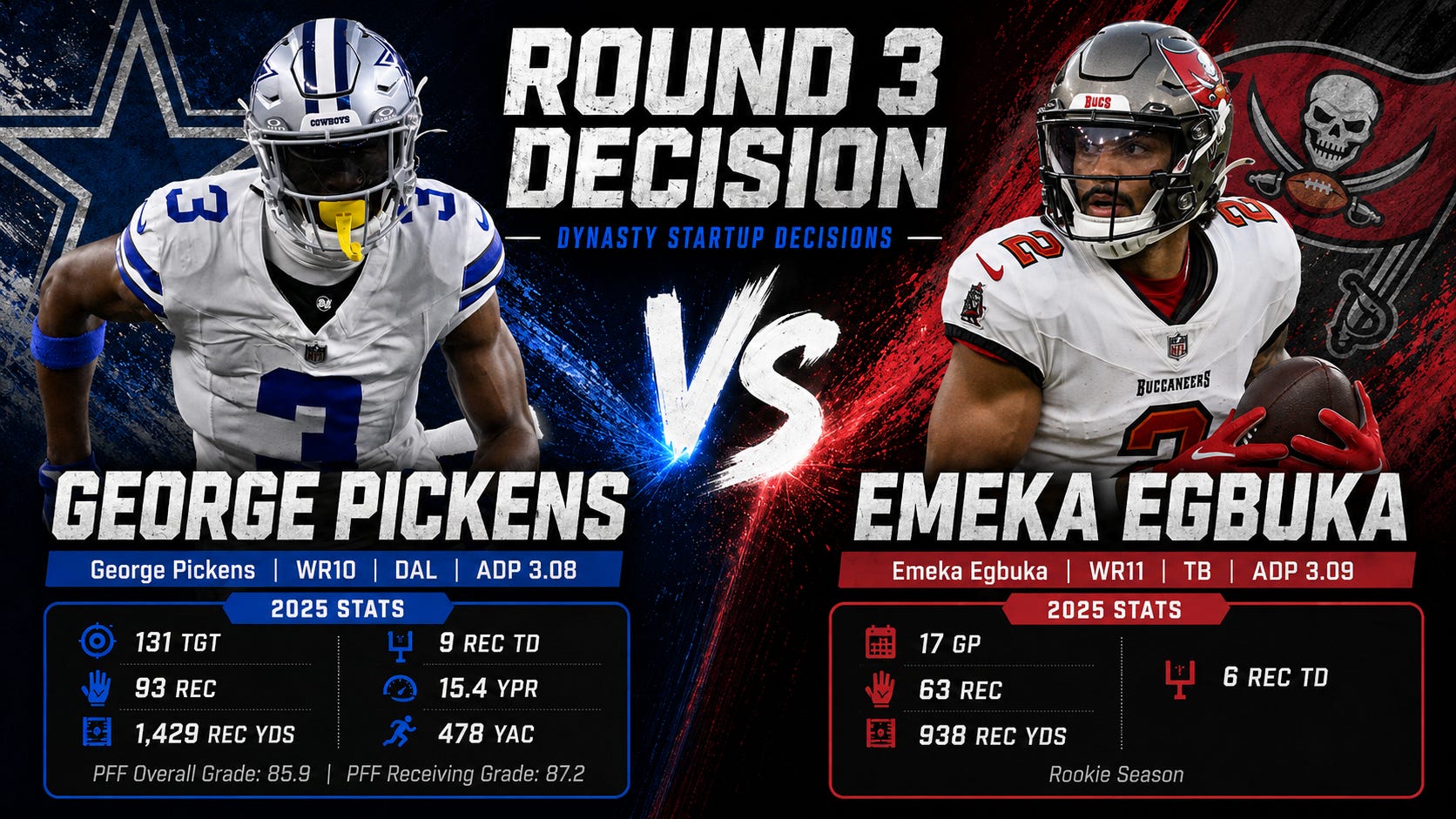
This one is a really interesting dynasty decision because it feels like a fork in the road between proven elite production and the younger ascending profile.
Emeka Egbuka is the youth play here. I completely understand why dynasty managers would want to lean that way. He flashed early as a rookie and looked like he was on the verge of a true breakout before the season got messy. The hamstring issue slowed him down, Mike Evans and Chris Godwin came back into the offense, and the role became a little less clean than it looked early in the year.
Now the situation looks much better heading into 2026.
Mike Evans is gone. Chris Godwin is another year older and coming off a brutal injury stretch. Tampa Bay needs a new engine in the passing game, and Egbuka has a real chance to become that guy. The WR1 role is there for him to take. If Baker Mayfield bounces back even a little from an accuracy standpoint, Egbuka could make a real second-year jump.
That is the case for Egbuka, and it is a good one.
But I lean George Pickens.
At some point, we have to stop treating Pickens like just a projection. He is no longer only the talented flashes guy. He went to Dallas and produced like a true difference-maker. In 2025, he caught 93 passes for 1,429 yards and nine touchdowns. That is not a small sample. That is not just an upside bet. That is elite wide receiver production.
The contract situation makes this interesting, but I do not view it as a major negative. Yes, Pickens is on the franchise tag. Yes, Dallas wants to see him do it again before committing long-term. But whether he stays in Dallas or hits the market, a player with his profile is going to command a major role. He is 25 years old, just posted a monster season, and has the type of vertical, contested-catch, alpha skill set NFL teams pay for.
Even with CeeDee Lamb demanding volume, Pickens still has a path to a massive ceiling in this offense. Dallas is going to throw the ball. The environment is good. The quarterback play is good enough. And Pickens has already shown he can win at a level that puts him in the low-end WR1 conversation.
Egbuka may end up being the cleaner long-term dynasty asset if everything hits. He is younger, attached to a vacated target tree, and has the second-year breakout narrative working in his favor.
But Pickens is already there.
This is where I am willing to side with the player who has already shown the elite fantasy ceiling. I like Egbuka, but I do not want to pass on a 25-year-old receiver coming off a 1,400-yard season just because the dynasty market is more comfortable betting on the younger name.
Pickens has become an elite asset. And even if he is not with the Cowboys long term, I believe he will be valued and used like a WR1 wherever he goes next.
Lean: George Pickens
4th Round
Dear Readers,
If you’re looking to get a real head start in your dynasty, devy, or C2C leagues, consider joining either our Substack or the website. Both provide actionable, edge-driven content built to help you stay ahead of the field.
Substack is our most affordable option at just $7/month and gives you access to all of our written content.
For those who want everything in one place, the website offers three membership tiers ($8/$12/$16) and includes all written content plus exclusive tools, rankings, features, and community access.
However you choose to support us, we truly appreciate you being part of what we’re building and trusting us to help you win.
