


Earlier this year, I introduced the TDR Devy Calendar, a framework designed to help devy managers understand one of the most overlooked aspects of the format: timing.
Too often, devy discussions focus exclusively on players. Who is breaking out? Who is rising up rankings? Who should we buy or sell? Those conversations matter, but they only tell part of the story.
The reality is that devy values move in predictable cycles throughout the year. Hype builds. Markets overreact. Managers panic. Opportunities emerge. Understanding when those value shifts occur can be just as important as identifying the right players in the first place.
That was the goal behind creating the TDR Devy Calendar.
The calendar breaks the devy year into monthly value windows, highlighting when markets are likely to become inflated, when buying opportunities emerge, and where managers can gain an advantage by understanding the psychology driving their league mates. If you missed the original article, I highly recommend checking it out, as it serves as the foundation for everything we’ll be discussing moving forward.
Win the Calendar: The TDR Guide to Devy Market Timing

Most devy managers spend all their time trying to identify the “right” players. They grind film, track recruiting rankings, monitor depth charts, and chase breakout candidates hoping they can land the next superstar before the rest of the market catches on. And while talent evaluation absolutely matters in this format, that alone isn’t what separates average managers from elite ones.
But the calendar was never intended to be a one-time exercise.
As we move through the year, I want to revisit each month individually and discuss how managers should be reacting in real time. Markets don’t always behave exactly the same way every season, but the underlying principles rarely change. By taking a closer look at each month as it happens, we can better identify where opportunities are developing and how to take advantage of them before the rest of the league catches on.
That brings us to June.
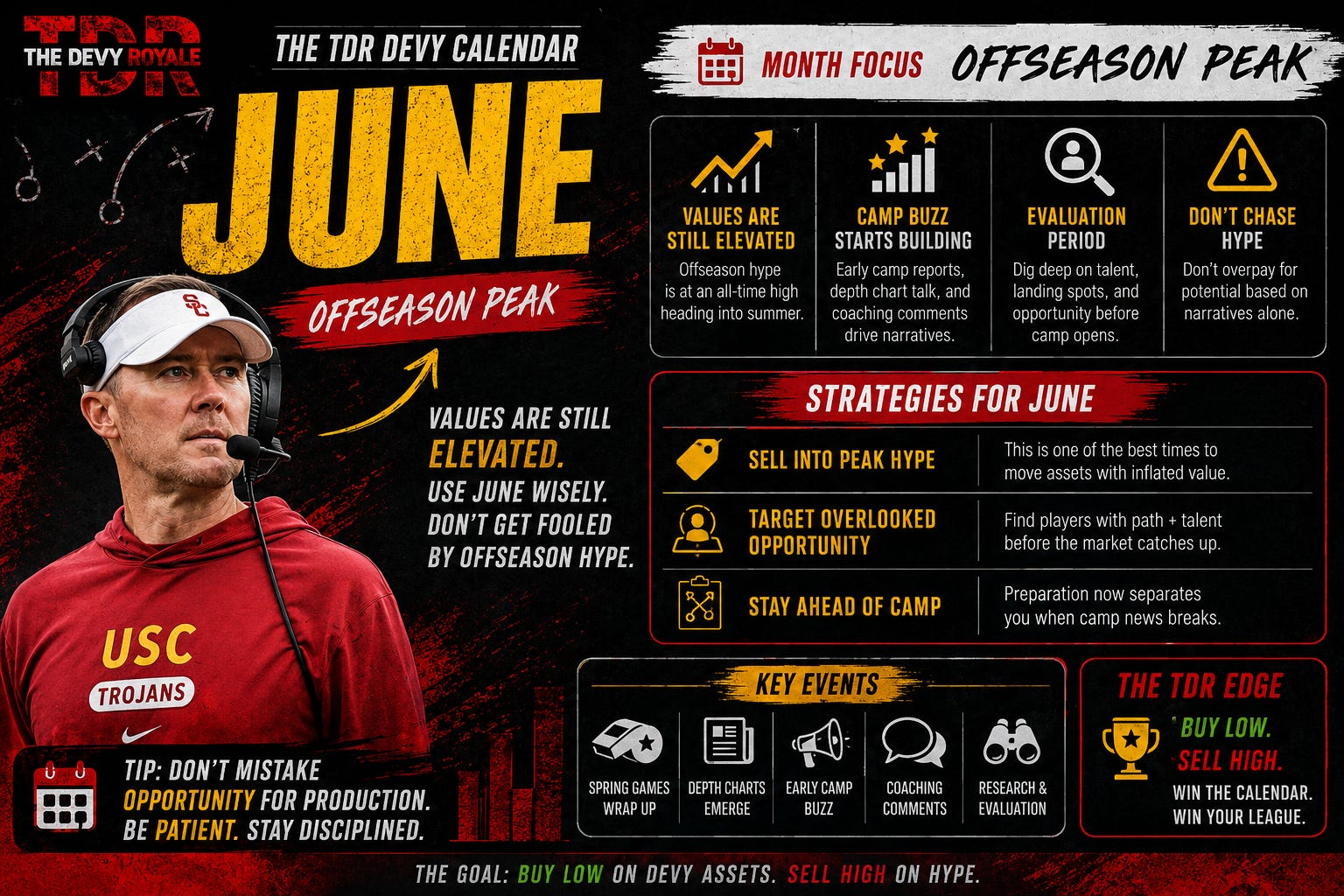
At first glance, June feels quiet. Rookie and most devy drafts are mostly complete. Spring practices have wrapped up. The season still feels far away. Many managers take their foot off the gas during this stretch.
That’s exactly why June matters. While much of your league checks out, attentive managers can begin positioning themselves for the next wave of value movement. The biggest edges in devy often aren’t created during the loudest months of the calendar. They’re created during the quiet months when nobody else is paying attention. Let’s dive into why June remains one of the more important months in the devy cycle and how managers can use it to gain an edge heading into camp season.
The June Market: Hype Is Still Expensive
Even though the draft is behind us, offseason optimism remains incredibly high. Freshman excitement is still alive. Vacated production narratives are everywhere. Post-spring risers are being pushed up boards. Updated rankings are dropping across the industry. And even though we are sitting in June, the market is still assigning future value based largely on projection.
That is the key part.
A lot of devy value in June is not tied to actual production. It is tied to what managers think could happen. They are buying opportunity, role projection, depth chart movement, recruiting profiles, spring buzz, and the idea of what a player might become. That does not mean those players are bad bets, but it does mean the market can get ahead of itself quickly.
This is where June remains a sell-leaning month on the calendar. The market has not fully cooled off from draft season yet. Managers are still excited about reshaping their rosters, still chasing the next breakout, and still trying to get ahead of the next wave of value movement. That optimism keeps prices elevated, especially for players who have strong narratives attached to them but still have not proven it on the field.
This is also where knowing where your league mates get their information from can create a real edge. A lot of the devy market moves in groups. One site pushes a player. Another site repeats a similar take. A few rankings update in the same direction. Then suddenly, everyone in your league is talking about the same handful of names. It becomes a herd mentality. Managers start chasing the same players because the same narratives are being repeated across multiple places. Or it works the other way with sites pushing down players.
That does not mean the information is wrong, but it does mean you need to understand how the market is being shaped. If you know your league is heavily influenced by certain sites, rankings, podcasts, or creators, you can use that to your advantage. You can identify which players are becoming overpriced because the market is repeating the same talking points. You can also spot the players being ignored because they are not part of the current content cycle.
That is a massive advantage in June. This is not the month to blindly chase every player getting offseason buzz. It is the month to ask why the buzz exists, where it is coming from, and whether the price already reflects the best-case scenario. If the market is paying for a projection like it has already happened, that is usually a good time to consider selling.
June is still active. It is just active in a quieter way. The managers who understand that can take advantage of a market that is still expensive, still narrative-driven, and still operating more on hope than proof.
Opportunity vs. Production
If there is one lesson devy managers need to understand in June, it’s this: Opportunity is not production. Every offseason we see players rise up rankings, startup boards, and trade values because people fall in love with projected opportunity. A player has vacated carries in front of him. A wide receiver room loses targets. A quarterback transfers out. A coaching change occurs. Suddenly managers start treating projected opportunity as if the production has already happened.
That’s dangerous. College football is one of the most volatile environments in sports. Depth charts change constantly. Freshmen emerge. Transfers outperform expectations. Coaching staffs make decisions nobody saw coming. What looks like a guaranteed role in June often looks very different by October.
In fact, I would argue this is the single biggest trap devy managers fall into every offseason. We convince ourselves that because a player has a path to touches, he automatically becomes a valuable asset. But talent still matters. Earning the role still matters. Producing with that opportunity still matters.
Last offseason, Oregon running back Makhi Hughes became one of the poster children for this type of thinking. Everywhere you looked, people were talking about his projected workload. The opportunity was there. The role was there. The path was there. He was being pushed up rankings and discussed as a player ready to capitalize on a favorable situation. Then football happened. Hughes finished the season with just 17 carries before eventually transferring. The opportunity everyone was projecting never materialized And that’s exactly the point.
The market often prices players based on what could happen rather than what is most likely to happen. As devy managers, we have to be careful not to confuse those two things. This doesn’t mean opportunity doesn’t matter. It absolutely matters. In fact, opportunity is often one of the biggest drivers of future value. But opportunity should be viewed as a piece of the puzzle, not the entire puzzle.
When evaluating players in June, I always try to ask myself a simple question:
“Would I still be interested in this player if the projected role wasn’t being discussed?”
If the answer is no, that’s usually a red flag. Talent should drive the evaluation first. Opportunity should enhance the profile, not create it. The managers who consistently win in devy understand this distinction. They don’t buy players simply because there are vacated carries or targets available. They buy talented players who have the ability to capitalize on those opportunities if and when they arrive. June is the perfect time to remember that. Because while the market is busy chasing projected roles, the smartest managers are still chasing talent.
Build Your Camp Watch List Now
The biggest mistake devy managers make in August is reacting. The biggest advantage devy managers create in June is preparing.
By the time a player is running with the first team in fall camp, wins a quarterback battle, or starts generating national buzz, the market has already begun adjusting. Values move quickly in August because everyone is consuming the same reports, reacting to the same headlines, and chasing the same narratives.
The sharpest managers are not building their watch lists in August. They’re building them right now.
June is the perfect month to identify players who could become camp risers before the rest of the market catches on. This isn’t about predicting every breakout correctly. It’s about identifying situations where value could move significantly over the next six to eight weeks.
When building a camp watch list, I focus on a few key questions:
Which players benefit from NFL departures?
Which second-year players are entering a critical development window?
Which freshmen have legitimate paths to early playing time?
Which quarterback battles could reshape an entire offense?
Which players have elite talent profiles but have not yet received mainstream attention?
Most importantly, I am looking for players whose values can change dramatically based on information that will become available during camp. Remember, camp reports don’t create talent. They reveal opportunity. If you’ve already identified the talent before the reports start rolling in, you’re operating ahead of the market instead of chasing it. Below are the players currently on my personal 2026 Camp Watch List. Some are household names. Others are deep stashes that could see their value jump significantly over the next few months. Regardless of where they currently sit in rankings, every player listed below is someone I’ll be closely monitoring as we move toward fall camp.
Quarterbacks
Dear Readers,
If you’re looking to get a real head start in your dynasty, devy, or C2C leagues, consider joining either our Substack or the website. Both provide actionable, edge-driven content built to help you stay ahead of the field.
Substack is our most affordable option at just $7/month and gives you access to all of our written content.
For those who want everything in one place, the website offers three membership tiers ($8/$12/$16) and includes all written content plus exclusive tools, rankings, features, and community access.
However you choose to support us, we truly appreciate you being part of what we’re building and trusting us to help you win.
